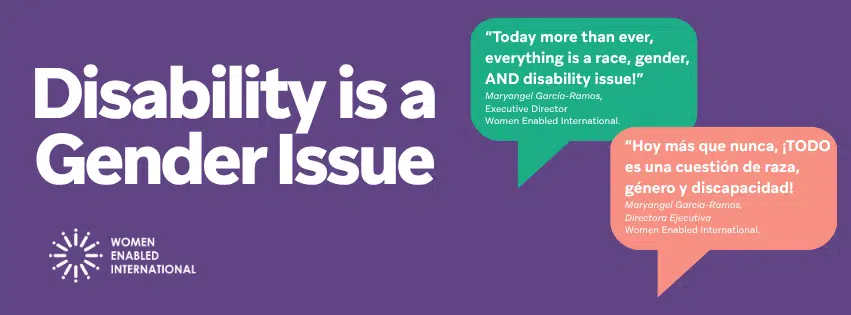
On August 19, 2026, Women Enabled International (WEI) released a first-of-its-kind trend report, “Disability Is a Gender Issue: How Feminist Disabled Leaders Are Shaping a More Just, Inclusive Future Amid Anti-Rights Challenges,” examining the growing threats to the rights of women, girls, and gender-diverse people with disabilities around the world. The report identifies six major universal trends affecting gender and disability rights: Democratic backsliding, rollback of gender equality protections, the misuse of human rights frameworks, framing gender as colonialism, rising armed conflict, increases in military funding causing a decrease in humanitarian funding. In response, WEI emphasizes putting feminist disabled leaders at the center because their advocacy and lived experiences are essential to building a more inclusive and democratic future.
This vital report highlights the many ways that a variety of anti-democratic movements are increasingly restricting community participation and weakening human rights frameworks for people with disabilities. According to WEI, these movements are abusing executive powers, repressing disabled leaders, and using wartime as an excuse to erode rights. In response, WEI asserts, feminists disabled leaders are training and organizing women, girls and gender-diverse people with disabilities to collectively push back. For example, WEI highlights the fact that a gender and disability advocate in West Africa established the “Women with Disability Watch, which trains women on their rights and the legal instruments that protect them against harm.”
These anti-democratic movements, WEI alleges, are also challenging gender equality through legislative rollbacks, restrictions on sexual and reproductive health and rights (SRHR), and efforts to limit LGBTQ+ rights particularly in the United States, India, and Argentina. Feminist disabled leaders are proactively monitoring and trying to hold states accountable as early as possible, so the erosion does not go unnoticed or unchallenged.
WEI’s trend report also examines how governments are, in some cases, advancing discriminatory agendas while reducing funding for international organizations and accountability systems. These developments disproportionately affect women, girls, and gender-diverse people with disabilities, who already face barriers to healthcare, education, employment, and political participation according to many metrics.
Anti-rights forces are also framing human rights as a “colonial import from the West” that threatens national independence, security, and sovereignty. These arguments are then used to justify restrictions on gender equality and abortion access. Anti-abortion groups have increasingly invoked disability rights to support restrictive policies. In response, feminist disabled leaders are working to protect bodily autonomy and expand abortion access through community education, public campaigns, media engagement, and collaboration across feminist and disability rights movements.
The trend report also examines how armed conflict intensifies existing inequalities. Women, girls, and gender-diverse people with disabilities face heightened risks of gender-based violence, displacement, and exclusion from essential healthcare and support services. They also highlight how armed conflict often increases disability and causes intergenerational trauma. Despite these challenges, feminist disabled leaders are providing essential services, supporting affected communities, and advocating for more inclusive humanitarian responses. The report highlights the critical importance of including these leaders in peacebuilding and recovery processes rather than excluding them from decisions that directly affect their lives.
The final trend WEI highlights is the declining availability of funding for gender equality and disability rights initiatives because of increasing military spending, government austerity measures, and preference to fund larger, (perceived) lower-risk organizations. These funding pressures often threaten the work of smaller organizations led by women with disabilities, while limiting access to the services necessary for independent living and bodily autonomy. In response, feminist disabled leaders are building coalitions across movements, monitoring government policies and budgets, and advocating for sustained investment in accessible, community-led initiatives.
WEI concludes their report by presenting a vision for a more just and inclusive future shaped by feminist disabled leaders. They call for equal decision-making power for feminist disabled leaders, accessibility be implemented into infrastructure, and shifting funding from short-term projects toward flexible, long-term support.
Ultimately, WEI argues that advancing disability justice is inseparable from protecting democracy, human rights, and gender equality. Maryangel García-Ramos the executive director for WEI, says “A democratic future rooted in gender equality cannot exist without feminist disabled leaders at its core. Disability cuts across every issue we care about—and our actions must reflect that reality. The time to center, resource, and support feminist disabled leaders is NOW.”
For those who’d like to know more about the full nature of WEI’s recent accomplishments, more insights can be found in Women Enabled International (WEI)’s 2025 annual report, “Our Existence Is Resistance!”, whichhighlights their work advancing the rights of women, girls, and gender-diverse people with disabilities around the world. The report emphasizes the importance of addressing gender and disability together, particularly with increasing attacks on gender equality and disability rights and declining funding for human rights and international development.
One of WEI’s major initiatives, Our Bodies, Our Rights!, was a program designed to address barriers women and gender-diverse people with disabilities face in accessing information about sexual and reproductive health and gender-based violence.
In addition, WEI also produced its Legal Capacity Project, where they examined how restrictions on legal capacity affect the sexual and reproductive health of women with intellectual and psychosocial disabilities by researches who have disabilities. The resulting 2025 report, “My Body, (but not) My Choice,” examined barriers to healthcare, access to information, and decision-making around marriage and having children, while also identifying how institutionalization and gender-based violence contributes to these violations.
Most critically, the organization argues that investing in feminist disabled leadership is essential to advancing gender equality, disability justice, and human rights. WEI’s work showed how community-led advocacy, inclusive research, and sustained investment can strengthen movements and ensure that people most affected by discrimination have a meaningful role in shaping the solutions.
More highlights from the Women Enabled International’s report are explored in an April 2026 video podcast episode: “Disability is a Gender Issue” by Marcela Reyes the director of communication and Maryangel García Ramos executive director for WEI