

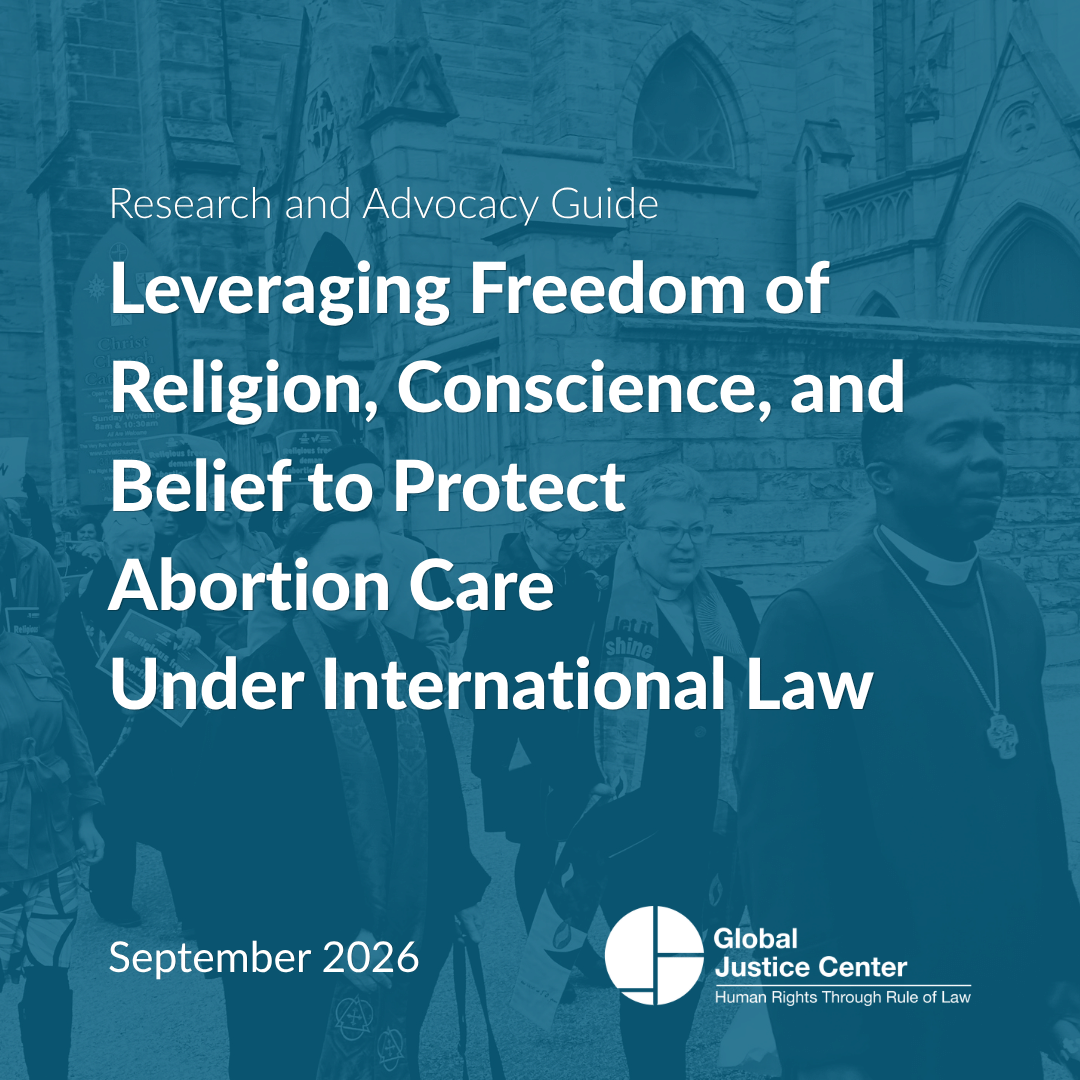
In September 2026, the Global Justice Center (GJC), a grantee of the Channel Foundation, released a report titled “Leveraging Freedom of Religion, Conscience, and Belief to Protect Abortion Care Under International Law.” This report serves as a research and advocacy guide, sharing an initiative that uses the human right to religious freedom and belief to protect reproductive rights under attack.
The Global Justice Center released this report in light of the U.S. State Indiana State Supreme Court hearing arguments in a case brought by a faith-based organization that argues Indiana’s abortion bans conflicts with its sincerely held religious beliefs that support abortion access. GJC shows further jurisprudence on this topic in the state of Utah in the United States, as well as internationally in Colombia and Canada. The GJC hopes this report will serve as a guide and background resource for legal practitioners, advocates, researchers, and policymakers. It aims to help them raise this argument in litigation, introduce individuals’ rights to freedom of religion, conscience, and belief (FRCB) in relation to abortion during legislative debates, and raise awareness of FRCB in pregnancy decision-making.
The report highlights four key takeaways:
- The right to FRCB does not only protect traditional values but also broader systems of belief.
- Abortion care may constitute a protected exercise of FRCB.
- Restrictions on FRCB must be prescribed by law, pursue a legitimate government aim, be necessary and proportionate to that aim, and not be imposed or applied in a discriminatory manner.
- States have an obligation to allow individuals to exercise their right to FRCB in the context of abortion.
The report defines this initiative as conscientious support, which author Jaime Gher defines as “the action of providing and/or supporting access to abortion care as an expression of one’s religion, conscience, or belief”. The report also provides international human rights standards as a legal framework that can protect individuals’ actions, including the Universal Declaration of Human Rights, the International Covenant on Civil and Political Rights, and many others including regional ordinances like the American Convention on Human Rights and the European Convention on Human Rights.
When a state criminalizes abortion, thereby taking a position on the issue, it endorses a particular viewpoint, often at the expense of individuals’ own conscientiously held beliefs. A state’s duty to protect human rights is not only violated when it unjustly infringes upon these rights, but also when it fails to adopt legislation that protects the right to FRCB.
Traditionally, the right to freedom of religion has been interpreted in a very narrow way, protecting only a limited range of religious viewpoints and beliefs. The idea of conscientious support aims to turn this concept on its head by reclaiming the narrative surrounding the use of religious belief to infringe upon the right to abortion care and instead using belief in a broader and more modern capacity.
The GJC also advises caution, noting that opponents may take advantage of the increased emphasis on FRCB to promote their agenda of religious-based refusal of care. It is therefore important to present a strong, fact-based claim to counter these arguments.
To make a strong claim, the GJC advises advocates to first demonstrate that the medical professional, third-party helper, or abortion seeker has a sincerely held belief protected under international law, show that abortion services are a protected a belief, research states’ legal obligations to protect FRCB, show that the denial of abortion care violates the individual’s belief, prepare counterarguments, and finally, they should identify the appropriate forum in which to bring the claim.
GJC’s goal is to protect not only individuals seeking abortion care but also the medical providers administering that care and third parties who help individuals access abortion care in any way possible. They have a long history of defending abortion rights in an international humanitarian settings. For example, they have bolstered efforts to get abortion care to people fleeing war zones and in many other areas in crisis. They want to protect abortion as a fundamental human right and use international law to do so, often using novel arguments like this one to do so.


